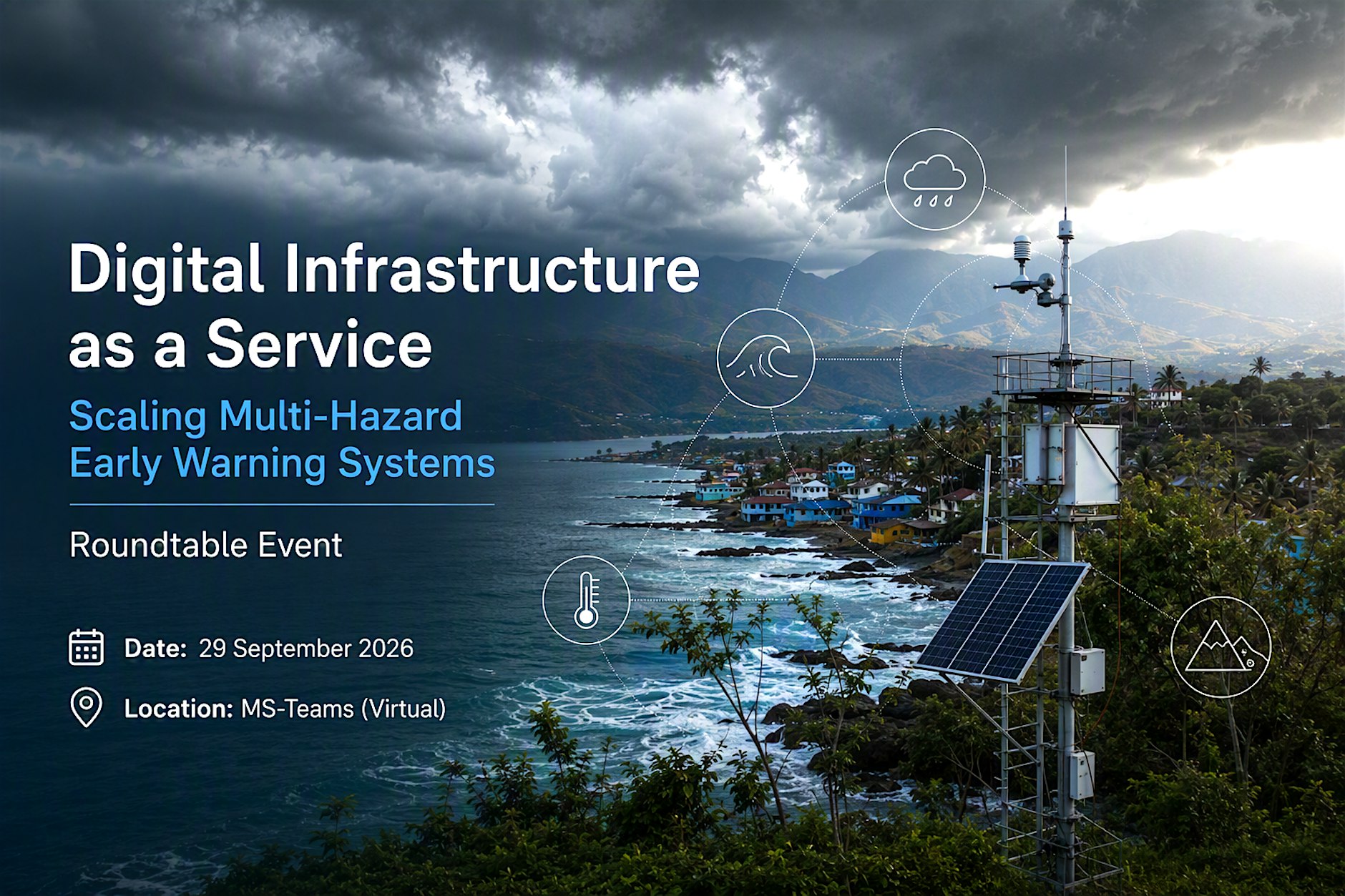
Digital Infrastructure as a Service – Scaling Multi-Hazard Early Warning Systems
Cardiff University | Cardiff | Wales
Round Table | 3pm – 4.30pm, BST (Find Local Time)
Duration: 1 Hour 30 minutes
Platform: MS Teams
Description: Multi-hazards refer to the simultaneous, cascading, or cumulative occurrence of multiple weather-, water-, and climate-related hazards. Rather than looking at extreme weather events in isolation (such as a single heatwave or flood), a multi-hazard approach examines how different hazards interact, overlap, or trigger one another, often amplifying overall risk and societal impact.
Nearly half of the countries still lack adequate multi-hazard early warning systems (MHEWS). Multi-hazards are a shortfall that disproportionately affects cities across the globe, especially vulnerable communities in the Global South, which are highly impacted as they have poor housing and inadequate resources to confront post-hazard response.
Increasing capacity in digital infrastructure to support AI and Data Science also offers opportunities to utilise some of this infrastructure for international development. Developing and hosting data centres is still limited across the Global South, offering opportunities to utilise capacity to support multi-hazard early warning systems that can be utilised globally. This RoundTable will showcase practical tools and mechanisms that can be used to support such predictive analytics and tools to support multi-hazard systems, identifying how data and computational infrastructure can be shared.
The RoundTable will identify links between short-term early warning with long-term resilience planning, policy, and finance to reduce losses.
UN SDG alignment: Goal 11 – Make cities and human settlements inclusive, safe, resilient and sustainable
Target 11.5: By 2030, significantly reduce the number of deaths and the number of people affected and substantially decrease the direct economic losses relative to global gross domestic product caused by disasters, including water-related disasters, with a focus on protecting the poor and people in vulnerable situations.
Target 11.9: By 2020, substantially increase the number of cities and human settlements adopting and implementing integrated policies and plans towards inclusion, resource efficiency, mitigation and adaptation to climate change, resilience to disasters, and develop and implement, in line with the Sendai Framework for Disaster Risk Reduction 2015–2030, holistic disaster risk management at all levels.